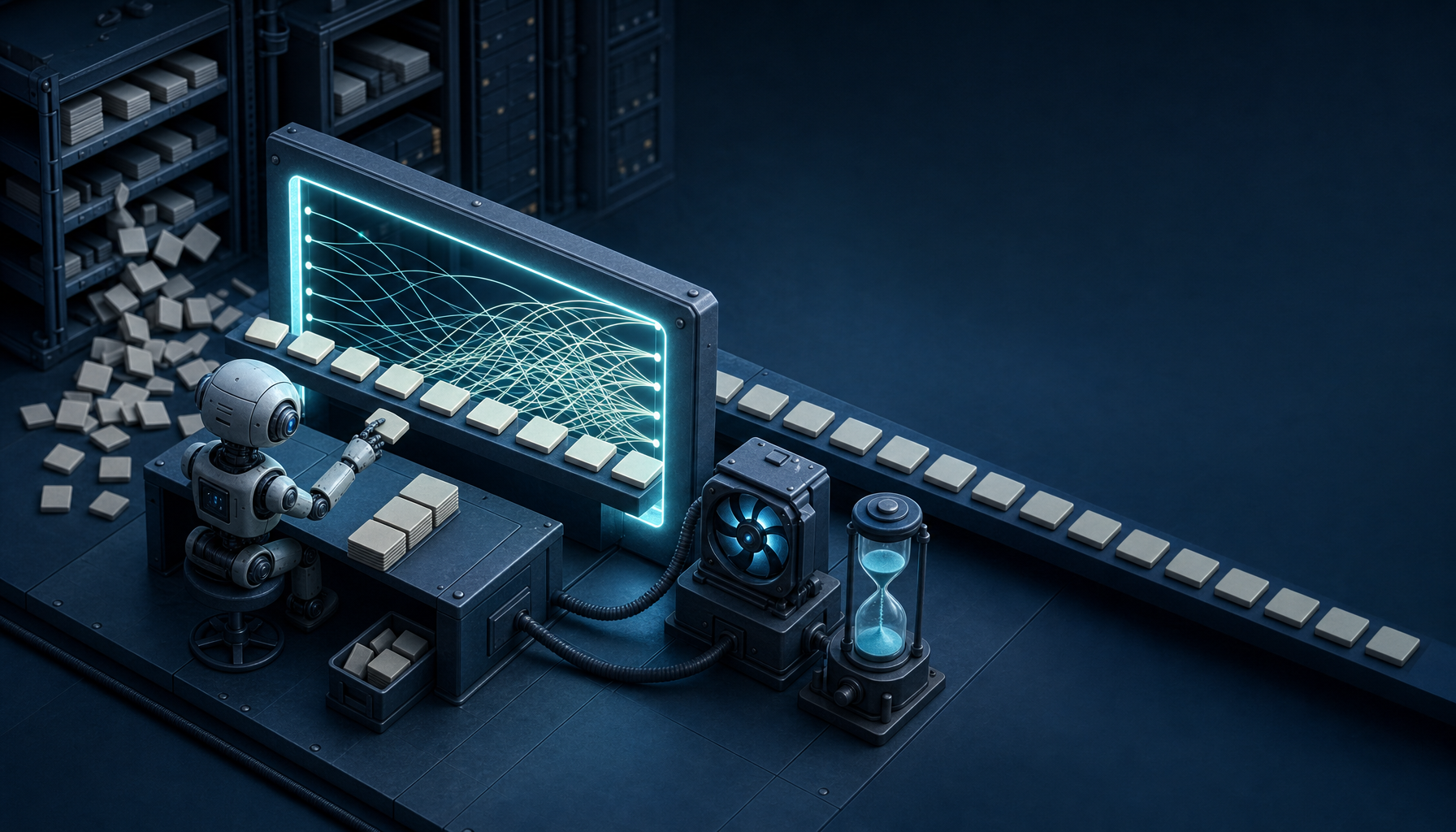
Why is the context window limited in LLMs? Because tokens are not free: every extra token increases compute, memory pressure, latency, and often confusion. If you are building GenAI features in Laravel, Node.js, or a microservice stack, this limit directly affects cost, UX, and architecture.
Quick Definition: Tokens, Not Words
An LLM context window is the maximum number of tokens the model can consider in one request. Tokens are chunks of text, not exactly words. You can inspect how text becomes tokens using the OpenAI tokenizer.
The context window includes both input and output. If a model supports 128k tokens and you send 126k tokens, you have almost no room left for the answer.
That is the first practical rule: never budget only for the prompt.
Why the Context Window Is Limited in LLMs
The core reason is transformer attention. In the original Transformer architecture, each token attends to other tokens to understand relationships. The paper Attention Is All You Need made this approach famous, and it still shapes most modern LLMs.
Transformer Attention Gets Expensive
As sequence length grows, attention work grows aggressively. A 10x larger context is not just 10x more convenient. It can mean much more GPU memory, slower inference, larger KV cache, and higher serving cost.
Modern models use optimisations, sparse attention, sliding windows, and better kernels. They help. They do not make infinite context cheap.
Token Limits Are Product Constraints
Even if a lab can run a huge context model, product teams still care about:
- First-token latency
- Cost per request
- GPU availability
- Output quality at long lengths
- Safety and prompt injection surface area
This is why the context window limited in LLMs is not a bug. It is a design boundary.
What Larger Context Windows Trade Away
Large context windows are useful, but they are not magic memory. In real systems, I have seen teams dump entire PDFs, chat histories, logs, and database exports into prompts, then wonder why the model misses the one relevant line.
Bigger context can create new problems:
- Lower signal-to-noise ratio: the answer hides inside irrelevant text.
- Lost-in-the-middle behaviour: models may pay less attention to content buried deep inside long prompts.
- Higher latency: users wait longer for the same task.
- Higher cost: every repeated token becomes recurring spend.
- Harder debugging: long prompts are painful to inspect and test.
For engineering managers, the takeaway is simple: context size is not a substitute for information architecture.
Practical Patterns: RAG, Summaries, and Token Budgets
The better pattern is to control what enters the prompt. For most production GenAI apps, I prefer a layered approach:
- Use RAG to retrieve only relevant chunks.
- Keep durable facts in a database, not in the prompt.
- Summarise long conversations after meaningful turns.
- Reserve output tokens explicitly.
- Log token usage per feature, tenant, and model.
Here is a simple token budgeting pattern I use before sending a request:
const MODEL_WINDOW = 128000;
const RESERVED_OUTPUT = 4000;
const SYSTEM_PROMPT = 1200;
const USER_MESSAGE = 800;

const availableForContext = MODEL_WINDOW - RESERVED_OUTPUT - SYSTEM_PROMPT - USER_MESSAGE;

function selectChunks(chunks) {
  let used = 0;
  const selected = [];

  for (const chunk of chunks) {
    if (used + chunk.tokens > availableForContext) break;
    selected.push(chunk);
    used += chunk.tokens;
  }

  return selected;
}
In production, replace rough token counts with model-specific tokenisation. Also rank chunks by relevance, freshness, access permissions, and business priority.
FAQ
Does a larger context window make RAG unnecessary?
No. Larger windows reduce pressure, but RAG still improves relevance, cost, security, and freshness. You usually want both.
Why can’t LLMs remember everything?
Most LLM calls are stateless. The model only sees what you send in the current request, unless you build an external memory layer using storage, retrieval, or summaries.
How should I choose a model context size?
Start with the smallest context that passes your real workflow tests. Measure p95 latency, cost per task, answer quality, and failure modes before upgrading.
Can summaries replace full context?
Sometimes. Summaries work well for conversation state, but they can lose exact facts. For legal, finance, healthcare, or audit-heavy flows, keep source snippets available.
Conclusion
So, why is the context window limited in LLMs? Because every token has an engineering bill: attention, memory, latency, cost, and quality risk. The best systems do not blindly chase bigger windows. They retrieve, compress, budget, and evaluate.
If you are designing a GenAI workflow and want a senior engineer’s review, reach out.