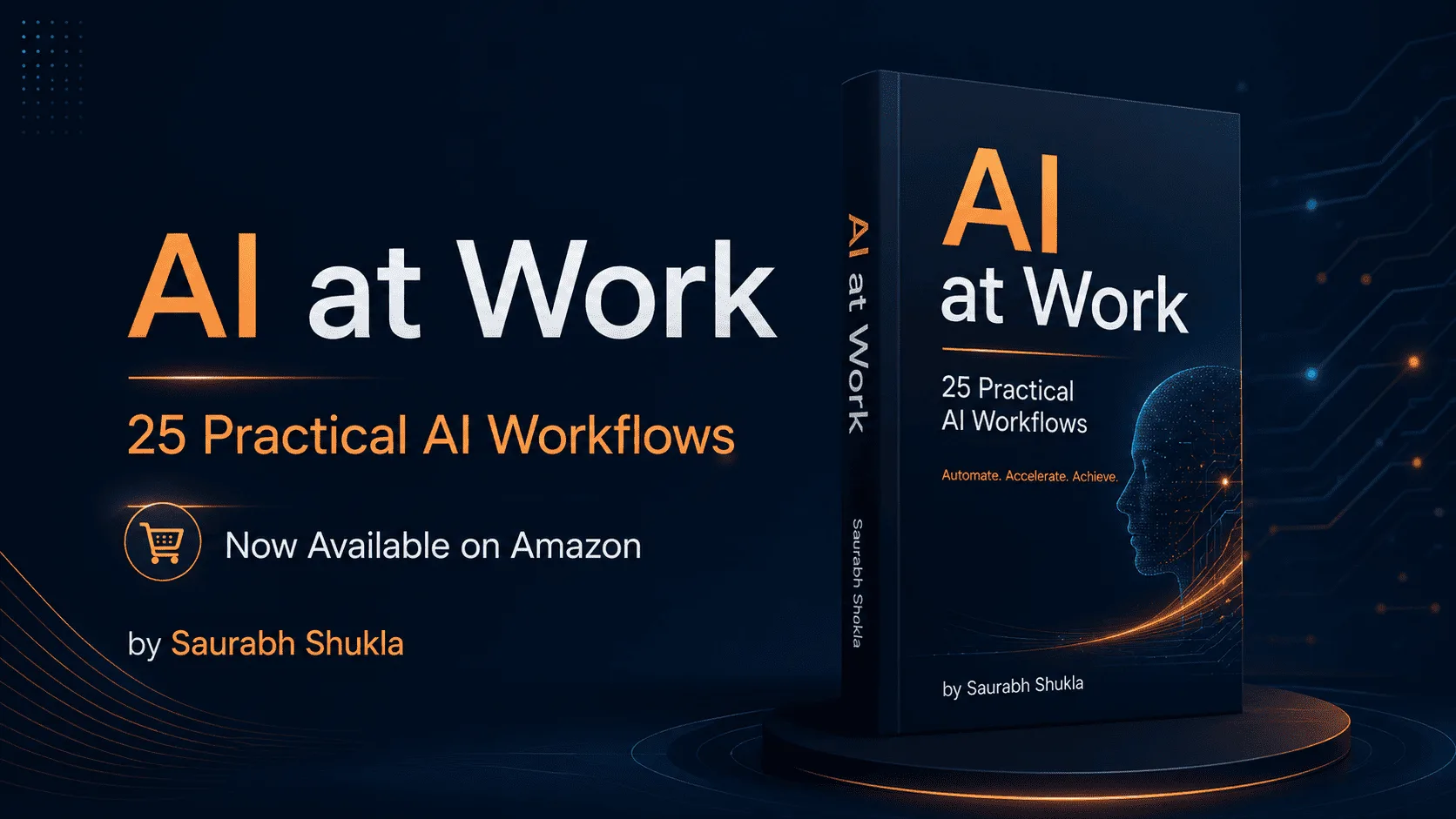
AI at Work: 25 Practical AI Workflows Is Now Available on Amazon
I’m happy to share that my book, AI at Work: 25 Practical AI Workflows, is now available on Amazon.
Over the last few years, AI tools such as ChatGPT, Claude, and Gemini have become part of everyday work for developers, marketers, founders, freelancers, students, and business professionals.
But there is still one common problem.
Most people know that AI can help them, but they are not always sure how to use it effectively in their actual day-to-day work.
That is exactly why I created this book.
What Is AI at Work About?
AI at Work: 25 Practical AI Workflows is focused on practical use cases rather than AI theory.
The book contains 25 workflows designed to help you use AI for tasks such as:
- Writing professional emails
- Summarizing documents and long content
- Researching topics faster
- Preparing reports
- Generating and organizing ideas
- Improving existing content
- Planning tasks and projects
- Working with large amounts of information
- Automating repetitive thinking work
- Improving personal productivity
The objective is simple: help you move from casually experimenting with AI to actually using it as a productive part of your workflow.
Why I Wrote This Book
There is already a huge amount of content available about artificial intelligence.
Most of it talks about new AI models, features, benchmarks, tools, and future possibilities.
While all of that is interesting, I wanted to focus on a much simpler question:
How can someone use AI today to save time and work more effectively?
You do not need to become an AI engineer to benefit from artificial intelligence.
In many cases, understanding how to structure a task, provide the right context, and communicate clearly with an AI model is enough to significantly improve your output.
That is the approach I have followed throughout this book.
Practical AI Instead of Complicated Theory
This is not a technical textbook about machine learning, neural networks, or large language model architecture.
The workflows are designed around real work.
For example, instead of simply explaining that AI can summarize content, the focus is on how you can structure a workflow to summarize information in a way that is actually useful.
Similarly, instead of saying that AI can help with writing, the goal is to show how it can assist with drafting, improving, reviewing, and restructuring content without completely replacing your own judgment.
The difference between casually using AI and using it effectively often comes down to the workflow.
Who Should Read This Book?
The book can be useful for anyone who regularly works with information, communication, research, planning, or digital tools.
It is especially relevant for:
- Software developers
- Working professionals
- Startup founders
- Entrepreneurs
- Freelancers
- Content creators
- Marketing professionals
- Business owners
- Students
- Anyone exploring AI productivity tools
You do not need advanced technical knowledge to follow the workflows.
If you already use tools such as ChatGPT, Claude, Gemini, or similar AI assistants, you should be able to start experimenting with many of the ideas immediately.
AI Should Reduce Work, Not Create More of It
One thing I have noticed while working with AI tools is that it is very easy to keep experimenting with new applications without actually improving productivity.
Every week there seems to be another AI tool, model, or platform to try.
But productivity does not come from using the maximum number of tools.
It comes from finding a few workflows that consistently help you complete your work faster or improve the quality of your output.
That philosophy became one of the core ideas behind AI at Work.
The goal is not to use AI everywhere.
The goal is to identify where AI genuinely adds value.
25 Workflows You Can Adapt to Your Own Work
The workflows in the book are not intended to be rigid templates.
They are starting points.
Someone working in software development may adapt a workflow differently from someone working in marketing, operations, consulting, or content creation.
That flexibility is important because the best AI workflows are usually built around your own responsibilities, processes, and working style.
Once you understand the underlying approach, you can modify the workflow for your own requirements.
Start Building Better AI Workflows
Artificial intelligence is becoming a normal part of modern work.
The important skill is no longer simply knowing that AI exists.
The real advantage comes from learning how to work with it effectively.
If this is something you are exploring, I hope AI at Work: 25 Practical AI Workflows gives you useful ideas that you can apply immediately.
The book is now available on Amazon India.
👉 Amazon:
https://www.amazon.in/dp/B0H23XTS8Y
If you read the book, I would also love to know which workflow becomes the most useful part of your daily work.